


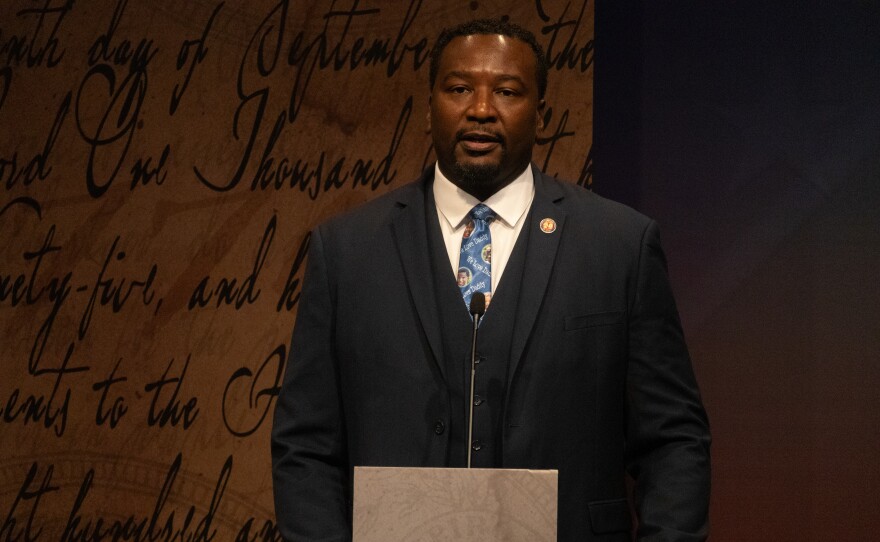
South Carolina's three Democrats vying for governor took to podiums Wednesday evening in the final televised debate before the June 9 primary election. The hour-long SCETV-hosted debate became more contentious than Monday night's Republican gubernatorial primary debate in which candidates rarely acknowledged each other.
Attorney Mullins McLeod, state Rep. Jermaine Johnson and businessman Billy Webster answered questions that ranged from immigration enforcement to data center policy. Each candidate made their pitch to voters with two days remaining in early primary voting and less than a week until the primary election.
Through June 2, more voters have participated in the Democratic primary election than the Republican primary; about 132,000 people have cast a ballot in the Democratic side of the bracket compared to almost 75,000 people who have voted in the Republican races. The candidates Wednesday worked to win-over voters on the journey to become South Carolina's first Democratic governor since Gov. Jim Hodges' term expired in 2003.
On that journey, though, candidates spent part of the night arguing amongst each other, as McLeod called out each of the other two by name multiple times.
A hot start that stayed lit
McLeod used part of his speaking time to call out Webster and Johnson, and it began after the first question asked by moderator and SCETV public affairs reporter Gavin Jackson. Candidates were asked about their path toward winning the General Election given the recent rarity of a Democrat being elected to a statewide office position.
Johnson said Democrats simply needed someone to light a fire in voters and reach people where they are.
"I have been going to places where they have never seen a candidate before, and people are fired up," he said.
Mullins, however, began his answer to the question by citing an electric utilities bill Johnson had attached his name to.
“The corruption in our state is bipartisan," he said. "When Mr. Johnson talks about the majority has been the problem, he fails to tell the people that he has voted with that super majority more than 90% of the time, and it’s not by an accident."
But Johnson said he did not support the bill — he was just looking for ways to make it more digestible.
"It's hard to throw rocks when you have not been in the fight," he said. "I worked directly with the Conservation Voters of South Carolina, with the Energy Justice Coalition and with members of the Sierra Club to put amendments in that bill to take it from horrible to a little bit better, and when you’re in the super minority in the Statehouse, that’s all you can do is help alleviate some of the pain of the people of South Carolina."
Mullins spoke after his allotted time numerous times to call out his opponents or finish his point. When answering a question about the state's growing population and infrastructure development, Mullins said private equity firms purchasing homes in South Carolina had driven up costs of living.
“They come in and build large supplies of single-family homes, and then they list them at prices that our citizens cannot afford," he said. We can slow down that development by simply banning private equity firms like Mr. Webster’s purchasing homes in South Carolina,” McLeod said.
Webster's response oozed of confusion.
“Most of the things Mr. McLeod says about me are just water vapor. I don’t know where they come from, I don’t know where they go,” Webster said. ”And if you’re going to be on the stage and run for governor, you better start checking your facts. What you just said is patently false.”
Johnson and McLeod did not initiate jabs at Mullins. The pair actually hugged at the event's close. Webster told reporters following the debate that he respected the state representative.
"Jermaine has made me a better candidate. I’ve never run for public office before. I don’t really know what this looks like," he said.
For Johnson, the feeling was mutual.
"He’s not a mudslinger, I’m not a mudslinger. We’re fighting for the people of South Carolina, and I think that’s what people need to see, is that people who have common agendas, common goals to fight for the people of South Carolina, they can have mutual respect," he said.
McLeod did not speak with the media following the debate. But the dramatics did not dominate the airtime even if they dominated the conversation afterward.


The similarities
Each candidate, despite their different relationships, was there to inform the public about their platform and potential policy. Baseline, the three sought an expansion of Medicaid, wanted change in the state's relationship with data centers and believed there was corruption in government.
All candidates said immigration enforcement and following the proper immigration process was necessary. But they each saw current federal immigration actions taken by U.S. Immigration and Customs Enforcement as overstepping.
"With respect to ICE and their role in law enforcement in our communities, if local communities need the support and help of ice, and local law enforcement requests the help of ice, then they should request a cooperative agreement and the federal government should pay for it," Webster said. "But ICE should not impose themselves into our communities unless they are requested."
For the most part, though, even if the candidates were in the same ballpark of idea, they had different plans to reach their goals.
The differences
Johnson and McLeod said the state needs to establish a livable minimum wage to help South Carolinians struggling with their finances. Mullins cited an $18-an-hour figure as appropriate. South Carolina does not have its own minimum wage and follows the federal minimum wage of $7.25 an hour. Webster said changes to healthcare like the expansion of Medicaid would be his plan of choice to help with affordability concerns.
In another fiscal-related question, candidates were asked about gambling in South Carolina. Johnson reflected on his negative personal experience with gambling in his family, but he ultimately said regulated casinos could be beneficial to the state. Webster said he had not looked enough into sports betting and horse betting to acknowledge that side of the gambling spectrum, but he agreed that added casinos with proper regulations would benefit the state. McLeod was not for the opening of casinos and said state efforts to expand gambling were misleading.
"I know that this is one of the main reasons that this establishment is coming after me," McLeod said in regard to his take on gambling.
Johnson and Webster said they valued their experience working with people who had opposing views. McLeod said bipartisanship was not the answer.
South Carolina is the fastest-growing state in the nation, according to the most recent U.S. Census Bureau estimates. Candidates were asked how they would deal with the growth of both population and infrastructure.
Webster said he would call a panel of professionals on development, conservation and infrastructure to put together a comprehensive plan on how to deal with the matter. Johnson's focus was on hearing from constituents and keeping people already in the state from leaving. McLeod said South Carolina's growth came from out-of-state for-profits, which he did not agree with, and wanted to ban private-equity firms from buying single-family homes in South Carolina.
Watch the full debate below:
What comes next
The June 3 debate was the final scheduled chance for voters to hear from Democratic candidates for governor in the same room before the election. More than 235,000 people had voted early as of 8:30 a.m. June 4.
Voters can cast an early ballot each weekday from 8:30 a.m. to 5 p.m. until Friday, June 5. A photo ID is required.
The primary election is June 9. If no candidate has a majority of the votes, then the two candidates remaining with the highest number of votes will appear in a runoff June 23.
